Our Location
Industriestrasse 111
4147 Aesch
Switzerland


Credo EV 350 Ref. · Precision. Emotion. Perfection.
Set it on its stand, start a record, close your eyes, and the loudspeakers vanish. The stage opens wider than the room seemed to allow, a voice stands in the middle, and the details arrive without being pushed at you.
The EV 350 Ref. is a compact monitor for people who sit close and listen closely. Swiss-crafted for those who hear the difference.
01 · Listening
A good loudspeaker shouldn’t ask you to trade anything away: not depth, not weight, not the sense of a real performer in the room. Voices stay relaxed, images precise, the bass honest, at the levels you actually listen at.
The bass reaches down with control rather than bloom. The midrange stays whole and coherent, so a piano sounds like one instrument, not a collection of frequencies. The treble opens up without an edge. Turn it up and it keeps its composure; turn it down late at night and nothing falls away.
It reveals every detail of the music, without adding or subtracting anything. That is the whole idea.
02 · The room
The EV 350 Ref. is at home where you sit close and listen in detail, and it fills a large room with music, too. What it doesn’t do is cinema-level volume; for higher levels in large rooms, the EV 1202 Ref. has more headroom. Placed on its isolation stand, it is decoupled from the floor, and the bass stays clean and articulate.
03 · Design
The EV 350 Ref. has a long history. Its line began with the SPC 350 in 1991, grew through an MKII and several revisions into the EV 350 Swiss Edition, and today’s EV 350 Ref. is in its seventh revision. Each step refined the same idea instead of replacing it.
Michael Kraske chose a 5.5-inch sliced-paper mid-woofer, whose cone stays calm where ordinary paper begins to break up, and a 1-inch soft-textile dome, both custom-made in Denmark. The crossover is time-aligned and pushes phase shifts outside the crossover range, so the two drivers meet without a seam. The cabinet is precision-machined and damped inside, so what you hear is the music, not the box.
Michael’s conviction is simple: a loudspeaker should not impose itself on the music. It should disappear, and leave only the artist’s intent.
Read Michael’s design statement ↗ · Datasheet ↗ · The science behind the emotion ↗
04 · Finishes and build
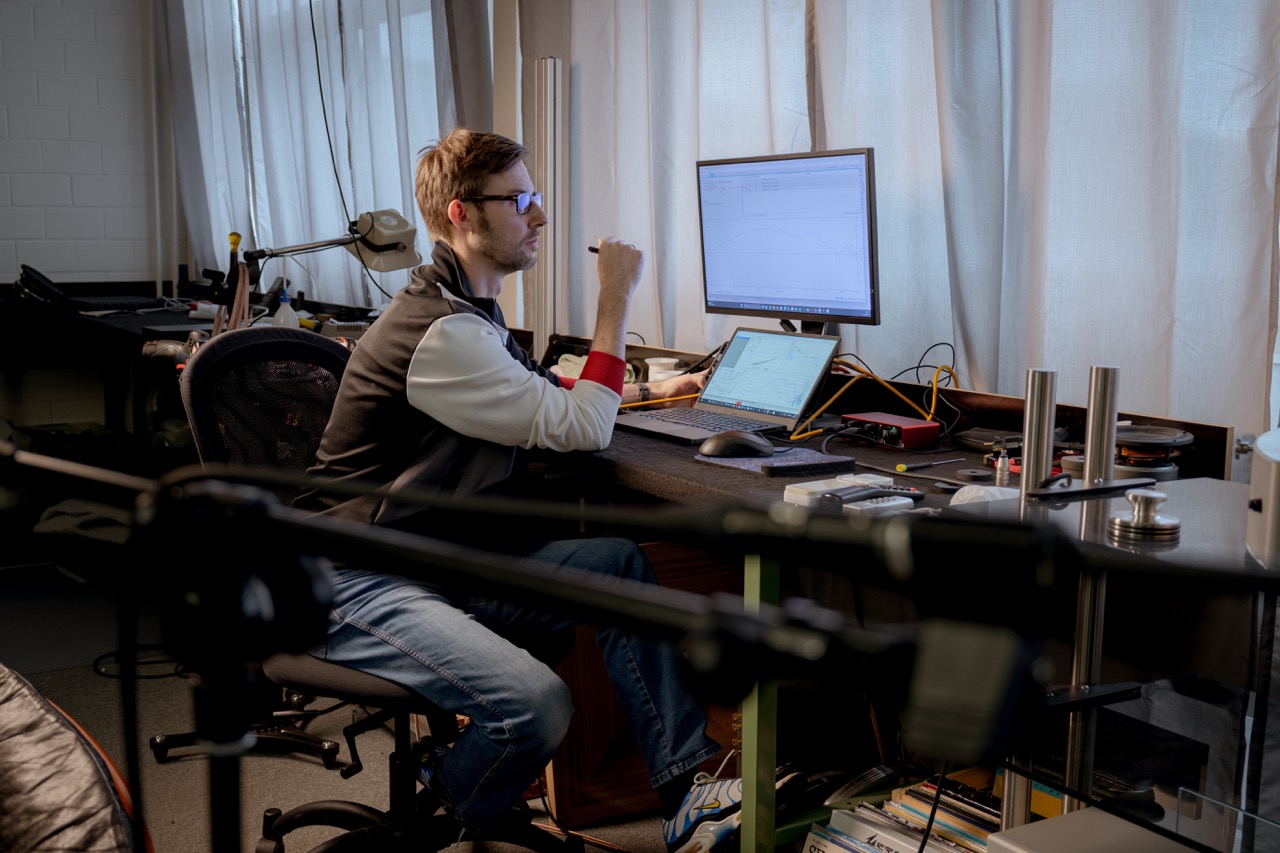
Piano Black, Swiss Pear and Oak, each pair veneered and matched together. Mechanical parts and crossovers are designed and assembled in our own workshop in Switzerland; the drivers and key components come from specialists in Denmark, Germany and the Netherlands. The cabinets are made of high-density European fibreboard, chosen for its acoustic behaviour and for sustainability.
Not built to fit a price point, but to sound right in a real room.


05 · Heard by others

“If someone handed me a pair of the EV 350s and told me those were the only speakers I could ever listen to for the rest of my life I’d say okay, thanks!”
Part-Time Audiophile · Marc Phillips, review 2022 · Read ↗
“I am enchanted with the Credo EV 350 Reference because its flaws are so few.”
Part-Time Audiophile · Marc Phillips, review 2022 · Read ↗
06 · Specifications
Measurements
Listening decides, but measurement keeps the listening honest. The EV 350 Ref. is measured to AES/CTA-2034-A: from 70 positions around the cabinet, to show how it will sound in a real room, not only straight ahead.
A gentle, deliberate dip of about 3 dB between 2 and 4 kHz, known among studio engineers as the “BBC dip”. Voices and strings stay clear, but never harsh or forward. That is why you can listen for hours.
Horizontal dispersion is smooth and symmetrical, narrowing predictably as the frequency rises, with a directivity index of 5.4 dB. Vertically, it stays broad up to the crossover. Reflections from the room carry the same tonal colour as the direct sound, and the stage stays stable.
The step response shows the tweeter and mid-woofer arriving in time and blending into one clean transient. The start of a note is sharp, and that is where the precision comes from. The impedance runs smooth, without sharp peaks.
Listening level
Most music is enjoyed far more quietly than loudspeaker brochures suggest. Professional mixing rooms work to a reference level of 83 to 85 dB, with peaks about 20 dB higher. In a living room, the same music feels just as loud at 76 to 78 dB, because you sit closer to the loudspeakers and to the walls.
| Room volume | Typical room | Reference level |
|---|---|---|
| Under 42 m³ | small room, near-field | 74 dB |
| 42 – 142 m³ | typical living room | 76 dB |
| 143 – 283 m³ | large living room | 78 dB |
| 284 – 566 m³ | very large room | 80 dB |
| Over 566 m³ | cinema, concert-sized room | 83 dB |
This matters, because hearing changes with level. The equal-loudness contours, first mapped by Fletcher and Munson, show that the ear loses sensitivity to bass and treble as the level drops, while the midrange stays prominent. A loudspeaker has to keep its full balance at real living-room levels, not only when it is played loud.
It is also why we don’t chase high efficiency. A passive loudspeaker that stays linear down into the deep bass reaches about 89 dB per 2.83 V at most; a higher figure on paper is paid for with weaker bass, exactly where the ear needs help at home. We design each model for its room size and listening distance instead.
The amplifier follows from there. We calculate it the way cinema and studio engineers do, to the CEA/CEDIA method: room volume, listening distance, reference level, peaks and honest headroom. For the EV 350 Ref., that typically means 20 to 30 W into 4 Ω in a small room or near-field setup. Tell us about your room, and we will calculate it for you.
07 · Questions and answers
A compact two-way monitor by Credo Audio Switzerland, at its best where you sit close and listen in detail. Its line goes back to the SPC 350 of 1991; today’s EV 350 Ref. is in its seventh revision and is built in-house in Switzerland.
It is at home where you sit close and listen in detail, and it fills a large room with music, too. What it doesn’t do is cinema-level volume; for higher levels in large rooms, the EV 1202 Ref. has more headroom.
It depends less on the loudspeaker than on your room and how loud you listen. We calculate it from room volume, listening distance and reference level. As a guide, 20 to 30 W into 4 Ω is enough for a small room or near-field setup.
Yes, it is designed to stand free on a stand. The Credo isolation stand decouples it from the floor and keeps the bass clean; it is available separately.
Because it is not tuned to win a short demonstration. A gentle dip between 2 and 4 kHz keeps voices clear but relaxed, the drivers are aligned in time, and the sound spreads evenly into the room.
Demonstrations are arranged directly with us or through our partners: credo-audio.ch/contact · Where to buy.
Next step
Some speakers are designed to impress in a showroom. Credo speakers are designed to reveal music in its purest form.
Bring the records you know best. We set up the system with you, then you sit down, take your time, and listen.
Press
Reviews and show reports, each linked to the original.
Part-Time Audiophile
Marc Phillips · Review, 2022
“This is a speaker where you must close your eyes to assess it, and then you will become as beguiled as I am.” Read ↗
Part-Time Audiophile
Buyer’s Guide · Best Bookshelf Speakers 2025
“… a balanced and natural sound. Killer imaging, and deep layers of detail …” Read ↗
Part-Time Audiophile
Marc Phillips · Credo Factory Tour, 2023
“… a low frequency response and a natural balance that is unmatched …” Read ↗
The Absolute Sound
Alan Taffel · Florida Audio Expo 2023
“There was even solid bass from the demure EV 350 Reference speakers …” Read ↗
Part-Time Audiophile
Marc Phillips · AXPONA 2022
“Imaging was incredibly focused.” Read ↗
AudioHead
Marc Phillips · AXPONA 2022
“I’ve never heard a small speaker that could energize a huge room with such aplomb.” Read ↗