Our Location
Industriestrasse 111
4147 Aesch
Switzerland


Credo Audio Switzerland · Cinema LTM
The breath before a phrase. The grain of a bow. The last trace of a decay. Cinema LTM brings them as close as great headphones do, then gives them the size, weight and air that only a real room can hold.
“Pinhead-sized micro detail with ocean-sized macro impact.”
Michael Lavorgna, Twittering Machines
Best Sound of Show, AXPONA 2024 · HiFi Pig. A fully passive line-source loudspeaker, designed and built in Switzerland for reference stereo systems and private cinemas.
01 · The moment
A voice suddenly stands in the room. An orchestra opens, and you forget there are loudspeakers at all.
Most systems give you that moment rarely: on one seat, at one volume, with the right recording. Turn it up and the sound hardens. Turn it down and the life drains out. Move to the side and the voice is gone.
Cinema LTM is built to give you that moment whenever you sit down. From a late-night whisper to full orchestral scale, across the seats of your room.
02 · The listening experience
Four things listeners describe, again and again.
A singer has chest, breath and a place to stand. Close enough to hear the lips part, solid enough to have weight.
“The recorded sound of this live performance seemed uncannily real.”
Jason Victor Serinus, Stereophile
Quiet listening keeps its detail. Full scale never turns into strain. The music opens up without pushing you back in your chair.
“Their natural and unforced delivery stood out from the sometimes very shouty presentations elsewhere.”
Christiaan Punter, HiFi Advice
Deep, fast and in tune. It carries a film score or a double bass without blurring the rest of the music.
“As deep, articulate and bloat- and boom-free as I’ve experienced.”
Michael Lavorgna, Twittering Machines
When the music grows, instruments stay in place and voices stay apart. Big, yet never a wall of sound.
“… sounded seamless, immense of scale, truly immersive, and exceedingly musical.”
Stereophile
03 · Before you listen
Three things people want to know first. More answers below ↓
Most cannot. A small monitor on a desk can feel that direct, but across a room the room takes over. Cinema LTM keeps that direct contact at real listening distance: the recording stays close, the sound has the size of the room.
“The Cinema LTM produce a similar kind of direct coupling … from a distance of 11 feet and more.”
Michael Lavorgna, Twittering Machines ↗
It sounds like one source. A voice stands in one place, with the focus people usually expect only from a single full-range driver, and with the scale only many drivers can deliver.
“This system puts [the singer’s] vocals solidly out in front and center stage … Which is kind of funny since the Cinema LTM are as far from a single driver as you can get.”
Michael Lavorgna, Twittering Machines ↗
That is what it was made for. Cinema LTM was born from a demanding project in Paris, and large rooms are its home ground. It fills them with ease, without turning loud into harsh.
“The system presented a big and bold sound in a large ballroom, energising the space with authority. A big space needs a big soundstage, which is what we got.”
Eric Neff, hi-fi+, AXPONA 2025 ↗
Gallery
Cinema LTM in private rooms, at shows and up close. Select an image to enlarge it.


04 · How it works
In every room you hear two things at once: the loudspeaker, and the room answering it. Floor, ceiling and walls return each note a moment later and blur it.
Cinema LTM is designed around that fact. It sends its sound to where people sit and keeps it away from where they don’t, so more of what you hear is the recording and less of it is the room.
05 · Sound in the room
Horizontally, Cinema LTM opens up across the seating area, so listeners beside the centre hear a similar tonal balance. Vertically, it concentrates its energy around ear height and sends less towards floor and ceiling.
Less sound reaching floor and ceiling means fewer late copies laid over the direct sound. A voice keeps its edge, and the reverberation in the recording stands apart from that of your room. That is the headphone quality: the recording close and intact, at the scale of the room.
Broad tonal coverage and stereo imaging are different things: the most precise stereo image remains at the central listening position. Listening height, seating and room geometry are part of planning the system.
Within its near field, a line source can lose level more slowly with distance than a compact source. The extent of that region depends on frequency and array length. The published directivity plots describe the LTM’s behaviour in more detail.
06 · One integrated source
Here is why so many drivers sound like one.
“I found it completely satisfying despite the fact that I’m not always into big array transducers.”
Marc Phillips, Part-Time Audiophile
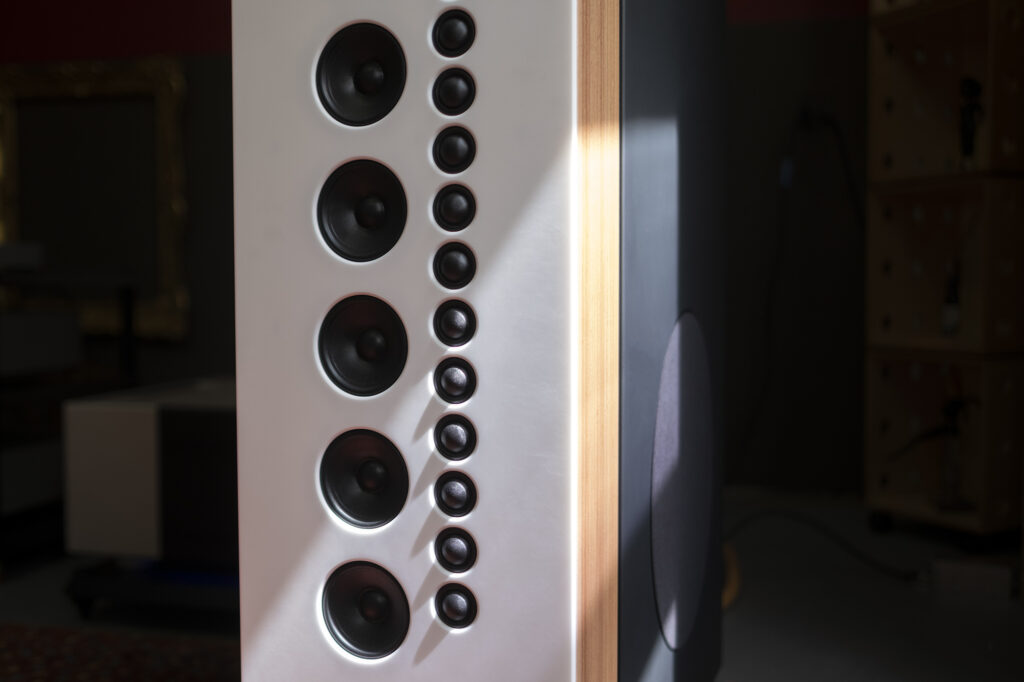
Each loudspeaker carries thirty-two tweeters and fourteen midwoofers. The passive crossover gives each driver its own weighted share of the signal, so their contributions add up along the listening axis and hold back above and below it. What reaches you is one wavefront from one calm source.
Because many drivers share the work, none has to strain, so fine detail and physical energy arrive together.
The principle comes from the constant-beamwidth (CBT) research of acoustician Don Keele. In 2010 he ranked seven types of line array on eight criteria, from even coverage and side-lobe suppression to the change of sound with distance. The shaded constant-beamwidth designs took the top places. Last came the unshaded straight line: equal drivers, or one large surface, driven uniformly from top to bottom. Its coverage narrows as frequency rises and it throws strong side lobes. That is how most tall driver columns, and every large, uniformly driven panel, behave.
Cinema LTM is not a copy of a research prototype. In Keele’s papers, a straight array was curved with electronic signal delays. Michael Kraske spent years turning the principle into a loudspeaker, from the earlier Cinema Reference to today’s fully passive three-way design, with shading and curving built into the crossover network itself. The development simulation shows the result: across the midrange and presence region, the energy is held within a controlled vertical angular range around the listening axis.
Shading is amplitude weighting: the drivers do not all contribute at the same level. Together with spacing and acoustic timing, it shapes how the sources combine and keeps unwanted lobes under control. The conceptual illustration shows the general principle, not the LTM’s exact driver layout or weighting profile.
07 · The right tool
Every loudspeaker has to decide what to do with the room. In a large room, five metres and more from the loudspeakers, that is no longer a question of taste. It is physics, and it can be measured.
A compact multi-way loudspeaker radiates almost as freely upwards and downwards as towards you, and its direct sound falls by 6 dB with every doubling of distance, following the inverse-square law. Close to it, the direct sound dominates.
Move further away, and the energy returned by floor, ceiling and walls grows in relation to it. Every reflection arrives a few milliseconds late and lays itself over the direct sound: what reaches you breaks up into reinforcements and cancellations that change with every seat and every listening height. The further you sit, the stronger that effect, and a large room puts its listeners far away.
Keele measured this in 2016, comparing a high-quality three-way studio monitor with a CBT line array over a reflective floor, at distances up to three metres. The monitor showed a deep floor-bounce notch and rough, uneven responses across distance and height; the CBT array stayed far more even. That was at three metres. Neither brand nor price changes that geometry.
We build compact two-way loudspeakers ourselves. In a living room, at three metres, they are the right tool. In a large room, at five metres and more, a point source is the wrong one.
A large planar or electrostatic panel is, acoustically, a straight dipole line: driven uniformly over its height, with no shading and no curving. In Keele’s comparison of seven line-array types, the unshaded straight line came last. A panel adds a rear wave to that. The consequences are not a matter of opinion. They follow from the geometry, and they can be measured:
Part of what is heard as air and openness is the room answering late. At five-figure prices, a loudspeaker should not ask you to accept its errors as character.
Cinema LTM solves the large-room problem at the source. Its passive array is broad across the seats and controlled in height, so floor and ceiling receive less energy, and the direct sound keeps its lead over the room further back than a point source can. Its sealed enclosures send no out-of-phase rear wave. And because many drivers share the work, scale does not run into the limits of a single diaphragm.
The right tool for the right job. For a large room, the job is clear: keep the recording ahead of the room, at every seat, at every level. That is what Cinema LTM is built for: the closeness of headphones, at the physical scale of a large room.
08 · Mechanical engineering
Precision in the air needs stillness in the structure. The front is a 12 mm cast polymer plate, chosen for stability and low resonance. Every driver is mounted from the rear, clamped, and reinforced with CNC-milled aluminium brackets.
The main cabinet is machined from a 120 mm block of laminated beech: 93 layers pressed into one dense, stable material. Midwoofers and tweeters work in separate sealed chambers, and the crossovers are mounted with vibration isolation.
The structure carries the drivers and stays out of the music.
09 · Passive system
Cinema LTM is a fully passive three-way loudspeaker. Array behaviour, filtering and driver integration are developed as one system. The array needs no processing to establish its behaviour; a dedicated bass section gives music and cinema their physical foundation.
The proprietary passive crossover uses Mundorf CFC air-core coils and MCap Supreme EVO capacitors. The current datasheet brings the construction, specifications and acoustic plots together, including frequency response, horizontal and vertical directivity, and step response.
10 · Independent listening
Best Sound of Show, AXPONA 2024. “A tight but full sound that I went back to several times during the show.” Stuart Smith, HiFi Pig
“This system provides as clear-eyed a view onto the sonic proceedings as I’ve ever heard.”
Michael Lavorgna, Twittering Machines ↗
“It was a truly musical and emotional experience listening to this system.”
The Audio Beatnik, Capital Audiofest 2019
“The big line arrays were on a whole other level.”
HomeTheaterHifi, AXPONA 2025 ↗
“I was awed by the midrange beauty of [the singer’s] voice … the soundstage was awesome.”
Jason Victor Serinus, Stereophile ↗
Show impressions describe complete systems with EMM Labs electronics, in rooms that were not our own.
11 · For architects and interior designers
Floor-to-ceiling glass, stone floors, concrete ceilings, open-plan living. It is the architecture clients love, and the hardest room a loudspeaker can play in.
Glass, polished stone and concrete reflect more than 90 percent of the sound that reaches them in the midrange and treble. A conventional loudspeaker sends its sound in almost every direction, so the room answers loudly and late. Voices lose their edge, film dialogue blurs, and music turns hard as the volume rises.
The usual cure is acoustic panels, heavy curtains and thick rugs: exactly what the design wants to avoid.
Cinema LTM sends its sound to where people sit and far less of it towards floor and ceiling. The direct sound stays ahead of the reflections, so clarity comes from the loudspeaker, not from treatment on the walls.
The most effective acoustic panel is the sound you never send into the room.
From a living room in Paris with two pairs of Cinema LTM to dedicated private cinemas, we plan with you from the first drawings: positions, sightlines and how the loudspeakers become part of the architecture.
In architecture like this, Cinema LTM is not one option among many. It is the loudspeaker designed for it.
12 · Questions and answers
Short, direct answers to the questions people ask before they listen.
Cinema LTM is a fully passive three-way line-source loudspeaker by Credo Audio Switzerland, designed and built in Switzerland for large listening rooms, private cinemas and reference stereo systems. Each loudspeaker stands 187 cm tall with a 27 cm wide front and carries thirty-two 22 mm soft-dome tweeters and fourteen 4-inch midwoofers, with a dedicated bass section as its foundation. Its aim is the closeness and detail of headphones at the physical scale of a large room.
In a large room, a loudspeaker has to keep its direct sound ahead of the reflections from floor, ceiling and walls. A compact multi-way point source loses 6 dB with every doubling of distance and radiates almost as freely towards floor and ceiling as towards the listener, so the further away you sit, the more the room shapes what you hear.
Cinema LTM is a line source with controlled vertical radiation. Within its near field, which for a line of its height reaches several metres from the midrange upwards, its direct sound falls by around 3 dB per doubling of distance instead of 6, and floor and ceiling receive less energy across the midrange and treble. It was designed for exactly this situation. For smaller rooms and listening distances of around three metres, Credo also builds compact two-way loudspeakers.
A large planar or electrostatic panel is, acoustically, an unshaded straight dipole line: driven uniformly over its height, without shading or curving, and radiating a rear wave of opposite polarity. In D. B. Keele’s comparison of seven line-array types (AES, 2010), the unshaded straight line ranked last; it produces strong vertical side lobes, and its treble narrows into a beam. Depending on placement, the rear wave returns from the wall behind and overlays the direct sound, and at low frequencies front and rear wave cancel each other.
Cinema LTM shapes its vertical radiation with passive shading and delay-curving, and its sealed enclosures have no open rear.
No. Cinema LTM is not a copy of D. B. Keele’s CBT designs, but it builds on the published research behind them: Legendre-based shading weights each driver’s contribution along the array to suppress side lobes, and delay-curving shapes the vertical coverage of the straight array. In Cinema LTM both are implemented passively, as part of a three-way system developed by Credo.
No. Cinema LTM is a fully passive loudspeaker. Shading, delay-curving and driver integration are built into its proprietary passive crossover, which uses Mundorf CFC air-core coils and MCap Supreme EVO capacitors. The array needs no processing to establish its directivity, and it is driven by power amplifiers like any passive loudspeaker.
Cinema LTM was designed for such rooms. Because it sends far less energy towards floor and ceiling than a loudspeaker that radiates in all directions, its clarity depends much less on acoustic panels, curtains or rugs. In a 35 × 40 ft (about 11 × 12 m) space without acoustic treatment, the in-room response measured ±2.75 dB from 30 Hz to 10 kHz at the listening position, with ⅓-octave smoothing, as documented in a published setup report. Every room is still planned individually.
Yes. Horizontally, Cinema LTM radiates broadly and evenly, so listeners across a seating area hear a similar tonal balance, which suits rows of seats in a private cinema and open living spaces. As with any stereo system, the most precise stereo image remains at the centre.
Yes, that is one of its design goals. Because the work is shared across many small drivers and the direct sound stays ahead of the room’s reflections, dialogue stays clear and the inner voices of an ensemble remain readable at late-evening levels. At high levels, the same principle keeps instruments in place and stops the sound from hardening.
Cinema LTM received Best Sound of Show at AXPONA 2024 from Stuart Smith of HiFi Pig. Michael Lavorgna of Twittering Machines reviewed a complete Cinema LTM system with EMM Labs electronics and wrote that it “provides as clear-eyed a view onto the sonic proceedings as I’ve ever heard.” Jason Victor Serinus of Stereophile described “the midrange beauty” of a singer’s voice and an “awesome” soundstage at a show with EMM Labs, Meitner Audio and VPI.
The main cabinet is machined from a 120 mm block of laminated beech made of 93 pressed layers. The front is a 12 mm cast polymer plate, chosen for stability and low resonance. Every driver is mounted from the rear, clamped and reinforced with CNC-milled aluminium brackets. Midwoofers and tweeters work in separate sealed chambers, and the crossovers are mounted with vibration isolation.
Demonstrations are arranged directly with Credo Audio Switzerland. For listening rooms, private cinemas and architectural projects, Credo plans the system with you, including positions, sightlines and integration into the design. Contact: credo-audio.ch/contact.
Next step
No description replaces the moment a voice stands in your room. For a listening room or a private cinema, we plan the system with you: the space, the seats and the music you love.